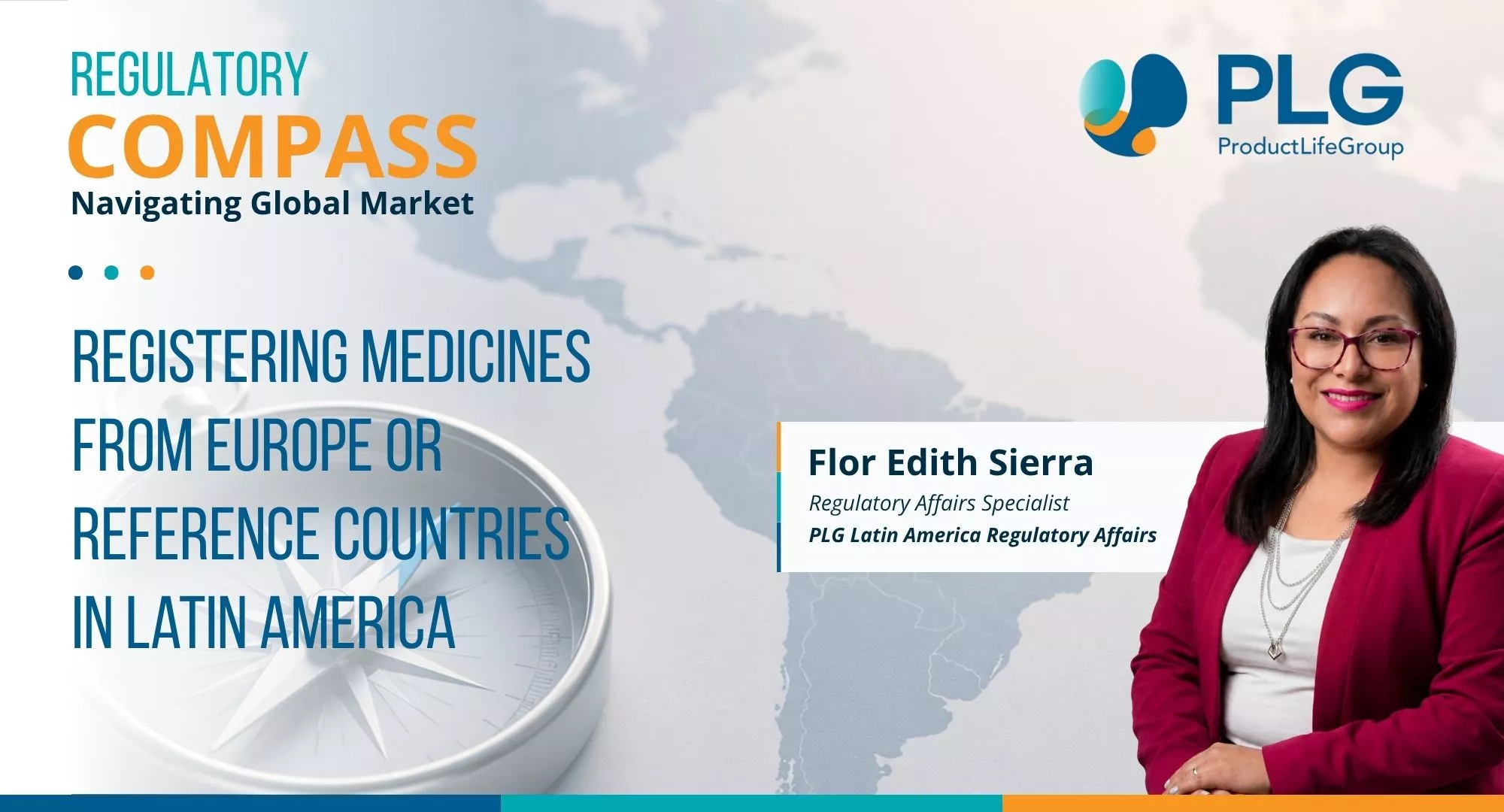
Registering Medicines from Europe or Reference Countries in Latin America
24 july 2026
“Regulatory Compass | Navigating Global Markets” is PLG’s ongoing series of expert insights from our regional regulatory affairs teams. Each article draws on direct field experience to help pharmaceutical companies anticipate challenges, make informed decisions, and accelerate their path to market – wherever in the world they operate.
Registering and marketing a pharmaceutical product in Latin America from the European industry is not as simple as one might hope when there is no joint strategy with the relevant departments or effective local regulatory support. Without sound strategic planning and an appropriate regulatory strategy, registering a medicine can be a very difficult task — even if it has been previously approved through a centralized or national procedure in reference countries with strict quality standards.
This situation is not because the medicine intended for Latin America is of lower quality, but primarily because of the following reasons.
1. Local regulations are undervalued or underestimated
This leads to the mistaken belief that the process will be simple simply because the product has been authorized in Europe or another reference country.
2. The global strategy is evaluated as regional rather than as a set of countries with autonomous and specific local regulations
This means assuming that the countries involved are evaluated in the same way. However, prior to submission, a self-assessment should be conducted in accordance with each country’s regulations, taking into account the specific requirements of each authority.
3. The different climatic conditions of the Latin American region are not considered
This results in the initial lack of stability studies for the corresponding climatic zone, the use of appropriate packaging materials for that zone, or even stable formulations under those conditions — for example, suspensions that could flocculate or thicken, or tablets without adequate protection from moisture or heat.
4. The selection of a local representative, regent, or partner who is inexperienced or untrained in the different countries where registration is sought
Choosing the right partner with a global, regional, and local regulatory perspective allows for the timely and appropriate communication of specific regulatory requirements from each authority, enabling the development of a sound strategy for submission, approval, and ultimately implementation for commercialization in the region or countries where registration is sought.
5. Manufacturers often lack the flexibility to generate regulatory documents for each country’s dossier
Only a regional dossier is available, and sometimes a global one. This is common when manufacturers prefer not to have multiple documents for the same product due to internal quality management considerations. Manufacturers often challenge their regulatory teams to submit a regional or global dossier, which can lead to deficiency letters or even rejections, resulting in delays in product launches or in the implementation of changes.
6. Lack of regulatory experience in the countries involved
This means that submission strategies are not evaluated from the outset to consider factors such as:
- shared packaging across concentrations and countries
- appropriate selection of materials, trademarks, and standardized information included in the shared packaging that complies with the regulations of each country involved
- failure to consider differences in approval times that may affect implementation and/or product launches
However, with proper strategic planning and consideration of the points mentioned above, the difficulty of registering a medicine in this region decreases, facilitating registration and, consequently, the marketing of products in Latin America. Even when Latin America may not have initially been a priority for the manufacturer, it later becomes an important market for maintaining current registrations and distributing products.
Author: Flor Edith Sierra, Regulatory Affairs Specialist – PLG Latin America Regulatory Affairs
Register to our news and events
Go to our Events to register
Go to our News to get insights