
EMA Stability Guideline Rev.3: Why It Changes the Way We Manage Post-Approval Variations in 2026
23 september 2026
"Regulatory Compass | Navigating Global Markets" is PLG's ongoing series of expert insights from our regional regulatory affairs teams.
Each article draws on direct field experience to help pharmaceutical companies anticipate challenges, make informed decisions, and accelerate their path to market – wherever in the world they operate.
The European Medicines Agency (EMA) has introduced Revision 3 of the Guideline on Stability Testing for Applications for Variations to a Marketing Authorisation (EMA/CHMP/QWP/441071/2011 Rev.3), effective from 15 January 2026.
While at first glance the update appears administrative, the practical implications for Regulatory Affairs, CMC, QA, and manufacturing organizations are far more significant.
For many years, stability studies supporting post-approval changes were often viewed as a submission requirement.
Rev.3 signals a clear shift toward lifecycle accountability.
Stability is no longer simply evidence required at the time of filing. Instead, it becomes a continuous obligation extending throughout implementation and post-approval monitoring.
What Has Changed?
The guideline remains focused on defining stability requirements for variations. However, Rev.3 introduces several important themes:
- Alignment with the revised EU Variations Framework
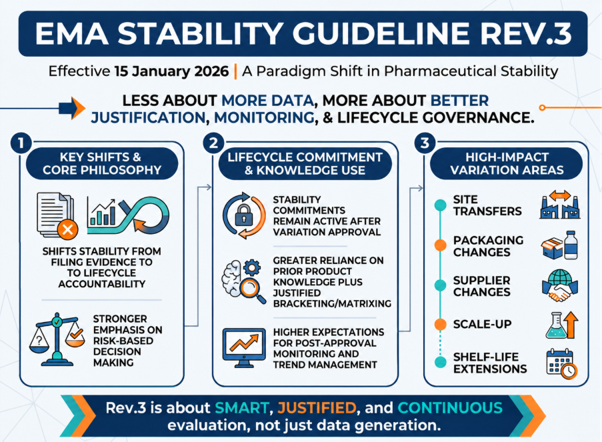
- Stronger emphasis on risk-based decision making
- Increased focus on commitment stability studies
- Greater reliance on prior product knowledge
- Reinforcement of scientifically justified bracketing and matrixing approaches
- Enhanced expectations for post-approval monitoring
The scientific principles themselves remain familiar. What has changed is the regulatory emphasis on demonstrating that stability considerations are fully integrated into lifecycle management.
Stability Commitments Are No Longer Administrative
One of the most important messages in Rev.3 is that stability commitments remain active long after variation approval.
For major post-approval changes, companies are expected to continue stability studies through the approved retest period or shelf life. Any emerging out-of-trend or out-of-specification result must be proactively assessed and communicated where appropriate. This represents a significant governance challenge for many organizations. Approval should no longer be considered the end of the stability story.
Impact on Common Variation Types
Consider a manufacturing site transfer. Under previous practice, companies often focused primarily on demonstrating process comparability and providing six months of stability data.
Under Rev.3, assessors are likely to focus not only on submitted data but also on:
- how stability risks were assessed;
- whether commitment batches are in place;
- how ongoing trends will be monitored;
- how the company will react if deterioration occurs after approval.
A similar mindset applies to:
- API supplier changes
- Packaging changes
- Scale-up activities
- Excipient modifications
- Shelf-life extension projects
Why the CMC Strategy Must Change
Future variation planning should begin with a question: “What stability evidence will we ultimately need to defend this change throughout its lifecycle?”
This approach aligns closely with ICH Q12 principles, where risk management, product knowledge, and lifecycle oversight are key enablers of more efficient post-approval change management.
Example
Imagine an immediate packaging change from a highly protective blister to a less protective alternative. Historically, teams may have focused on generating the minimum stability package required for submission.
Under Rev.3, regulators are more likely to expect:
- scientific rationale supporting package selection;
- analysis of moisture and oxygen protection;
- comparative stability evaluation;
- an ongoing monitoring commitment.
The discussion moves from compliance to scientific understanding.
What Should Companies Do Now?
Three practical actions should be prioritized:
- Review variation assessment procedures and incorporate explicit stability-risk evaluation.
- Upgrade stability commitment tracking systems.
- Reassess ongoing portfolio projects involving site transfers, packaging changes, supplier changes, and shelf-life extensions.
Organizations that build stability into change-control planning will be better positioned to avoid regulatory questions and implementation delays.
In our experience working alongside CMC and QA teams on exactly this kind of transition, the science rarely is the hard part — most teams already understand the chemistry. What tends to break down is the operational side: who owns a stability commitment three years after approval, how trends get flagged before they become deviations, and whether a company can actually reconstruct and defend its reasoning if an inspector asks. Rev.3 makes that operational discipline a regulatory expectation rather than good practice, and it’s exactly where an experienced regulatory partner earns its place — helping teams translate the guideline’s expectations into a system that holds up over the full lifecycle of a product, not just at the moment of submission.
If your team is reassessing how site transfers, packaging changes, or shelf-life extensions are handled under Rev.3, our regulatory affairs specialists can walk through your specific portfolio with you.
Final Thought
Rev.3 does not dramatically increase the quantity of stability data expected by regulators. Instead, it raises expectations around how those data are interpreted, justified, monitored, and managed throughout the product lifecycle.
In that sense, Rev.3 is less about stability testing and more about stability monitoring. The companies that recognize this shift early will have a significant advantage in managing future post-approval changes efficiently and compliantly.
References:
EMA/CHMP/QWP/441071/2011 Rev.3 and EMA/CHMP/CVMP/QWP/441071/2011 Rev.2.
The Author:
 |
Vinod RamakrishnaCMC Team Lead |
Register to our news and events
Go to our Events to register
Go to our News to get insights