What’s Changing in MDR — and How to Prepare Your Organization Now
27 april 2026
Discover the latest regulatory developments shared at the Medical Devices Forum
The Medical Devices Forum, a one-day event held in Italy and produced by Pharma Education Center, a partner of ProductLife Group, addressed urgent medical device topics for industry professionals, bringing perspectives from local health authorities, notified bodies, industry associations, ethics committee, and other industry experts.
One topic dominated the discussion – navigating the Medical Device Regulation (MDR).
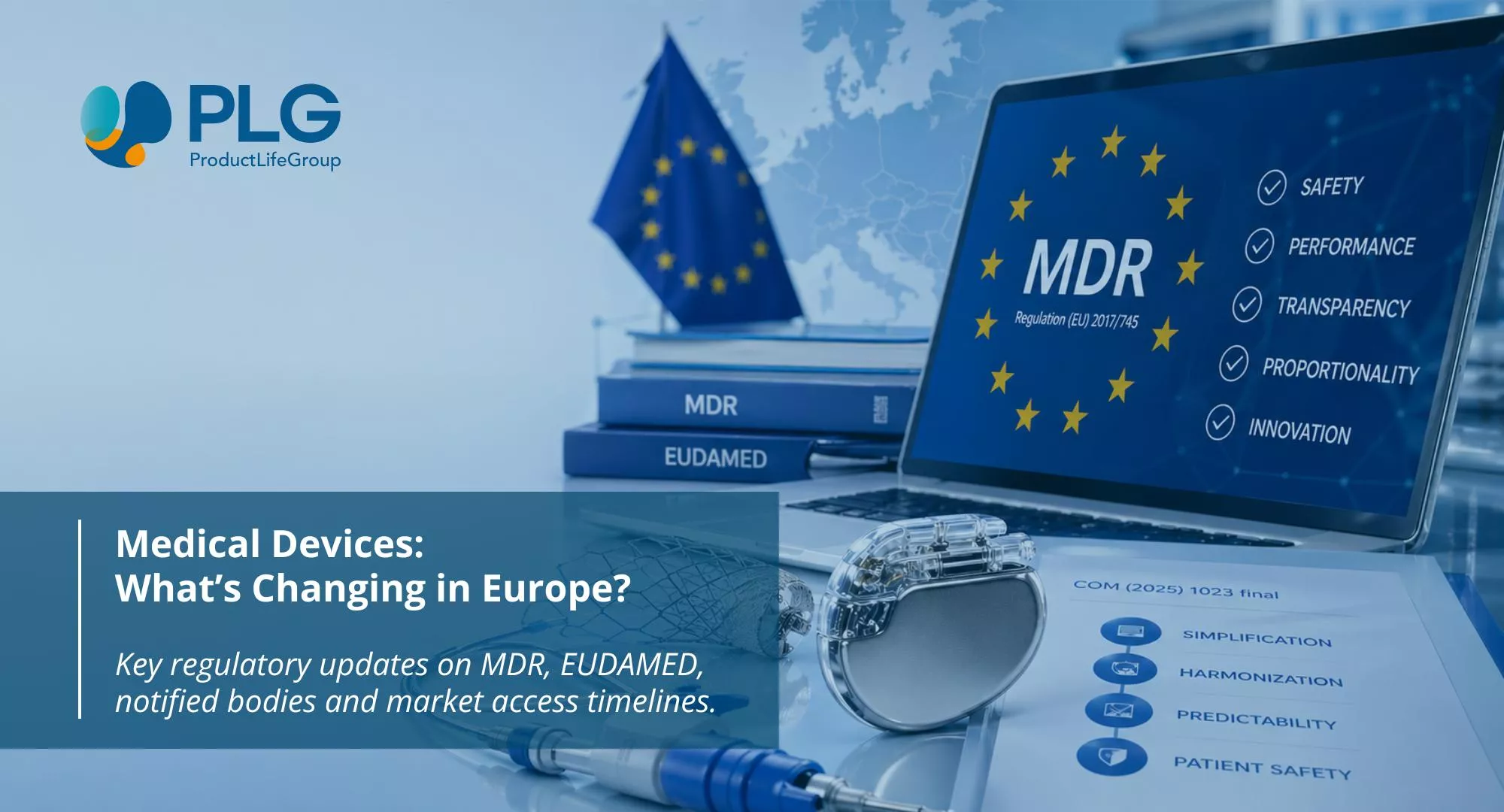
The proposal for the revision of the MDR, European Commission proposal COM (2025) 1023 final, adopted in December 2025, is now under evaluation by the European Parliament and Council.
This proposal was strongly promoted by industry associations and patient organizations to address the shortage of medical devices caused by the practical implementation of the MDR, which introduced rigidity and, as a result, uncertainty in certification timelines.
Key drivers of the proposal are administrative burden reduction and proportionality, meaning that the level of scrutiny applied to a medical device is directly proportional to its risk level.
As a result, the proposal is expected to lead to more predictable certification timelines and, therefore, to a more secure and timely release of medical devices into the market.
Simplification Measures Include:
- Revised criteria for Periodic Safety Updates Reports (PSUR) issuance in post‑market activities
- Lighter assessment of technical documentation for Class IIa devices
- Introduction of a list of well‑established technology (WET) devices that may benefit from derogations in the conformity assessment process
- Differentiated certificate validity criteria depending on the product
- Publication requirements in EUDAMED, an IT system that provides a living picture of the lifecycle of medical devices available in the European Union (EU)
- Changes in sector governance (four subgroups) aligned with European Medicines Agency (EMA)
The approval pathway for the proposal may require 18 to 36 months to complete the legislative steps between the European Commission and Parliament.
New National Database 2.0
The current database system is transitional until May 2026. At present, economic operators may register either in EUDAMED or in the national system.
From May 2026, the new national Database 2.0 (BD 2.0) is expected to enter into force. This system will automatically import manufacturer data from EUDAMED, and direct access will not be allowed. Manufacturers will only be able to upload labels and instructions for use.
EUDAMED
Some modules have already been declared functional and mandatory.
As of May 28, 2026, six months after the publication of Commission Implementing Decision (EU) 2025/2371 of 27 November 2025, the first four EUDAMED modules will become mandatory:
- Actor Registration (registration of manufacturers, authorized representatives, importers, and assignment of the Single Registration Number – SRN)
- UDI/Devices (assignment of UDI identifiers)
- Notified Bodies & Certificates (uploading and management of MDR/IVDR certificates)
- Market Surveillance (reporting and management of market surveillance activities by competent authorities)
Change Management: What’s New?
Change management is a central process in the medical device lifecycle under Regulation (EU) 2017/745 (MDR).
The regulatory framework has been further strengthened through the latest position paper currently under finalization and not yet published.
This document aims to harmonize and improve the efficiency of the change management process. Developed with the involvement of several notified bodies, it spans approximately 50 pages and provides detailed clarification of key interpretative issues, while also defining clear and predefined timelines.
Once issued, this valuable document is expected to serve as a robust guideline to improve change management processes, ensuring greater consistency in decision‑making, alignment of interpretations, and harmonization of review timelines across notified bodies.
Amendment to Annex VII MDR: Requirements for Notified Bodies – What’s Changing?
The amendment to Annex VII of Regulation (EU) 2017/745 (MDR) aims to strengthen and harmonize the requirements applicable to notified bodies, addressing practical implementation issues identified since the application of the MDR in 2021.
The amendment, introduced through a draft Commission Implementing Regulation (December 2025), does not change the core structure of Annex VII but will reduce significant differences in behavior among EU Notified Bodies and improve assessment timelines.
This will lead to greater transparency in costs and process durations, greater fairness among manufacturers, and improve predictability of market access and timelines.
Well‑Established Technologies (WET): What’s New for Manufacturers?
Well‑Established Technologies are mature medical technologies with consolidated safety and performance profiles, for which is allowed more proportionate clinical and assessment requirements, provided they are adequately justified.
Some technologies are considered WET for the purpose of clinical investigation derogations when sufficient clinical data are available (historical data, PMS, literature, equivalence) based on Article 61(6)(b) MDR.
For certain Class IIb implantable devices, the assessment of technical documentation may be conducted on a sampling basis, rather than on every single device based on Article 52(4) MDR.
Recent regulatory developments don’t create a “WET shortcut,” but they clarify how WET can be leveraged.
Role of the Notified Body and Ethics Committee in Clinical Evaluation
The Ethics Committee protects individuals, while the notified body protects regulatory compliance. Both are essential, but they have distinct and non‑overlapping roles in the clinical evaluation process.
The Ethics Committee is involved only if the manufacturer conducts a clinical investigation under Articles 62–82 MDR (legal basis: Chapter VI MDR – Clinical Investigations).
The Ethics Committee assesses ethical and subject‑protection aspects, not the clinical evaluation itself, including:
- Study protocol, informed consent, risk/benefit proportionality, adequacy of subject information, competence of investigators
The Ethics Committee is responsible for ensuring that the informed consent is written in a clear and understandable manner for patients signing and authorizing the use of their data. It must also ensure that the study objectives and its contribution to scientific advancement are clearly explained to the patient.
Within the framework of Regulation (EU) 2017/745 – MDR, PROMs (Patient‑Reported Outcome Measures) are structured tools—typically validated questionnaires—used to collect information on clinical outcomes directly from patients, without interpretation by physicians or healthcare professionals.
This overview highlights the key upcoming developments in the medical device sector. If you would like to delve deeper into topics relevant to your organization, discover more today.
Navigate EU MDR changes with confidence and clarity. Get expert support tailored to your organization—contact us:
Register to our news and events
Go to our Events to register
Go to our News to get insights