World Health Day 2026: when science is not enough
03 april 2026
Why turning evidence into trusted health solutions is the defining challenge of our time
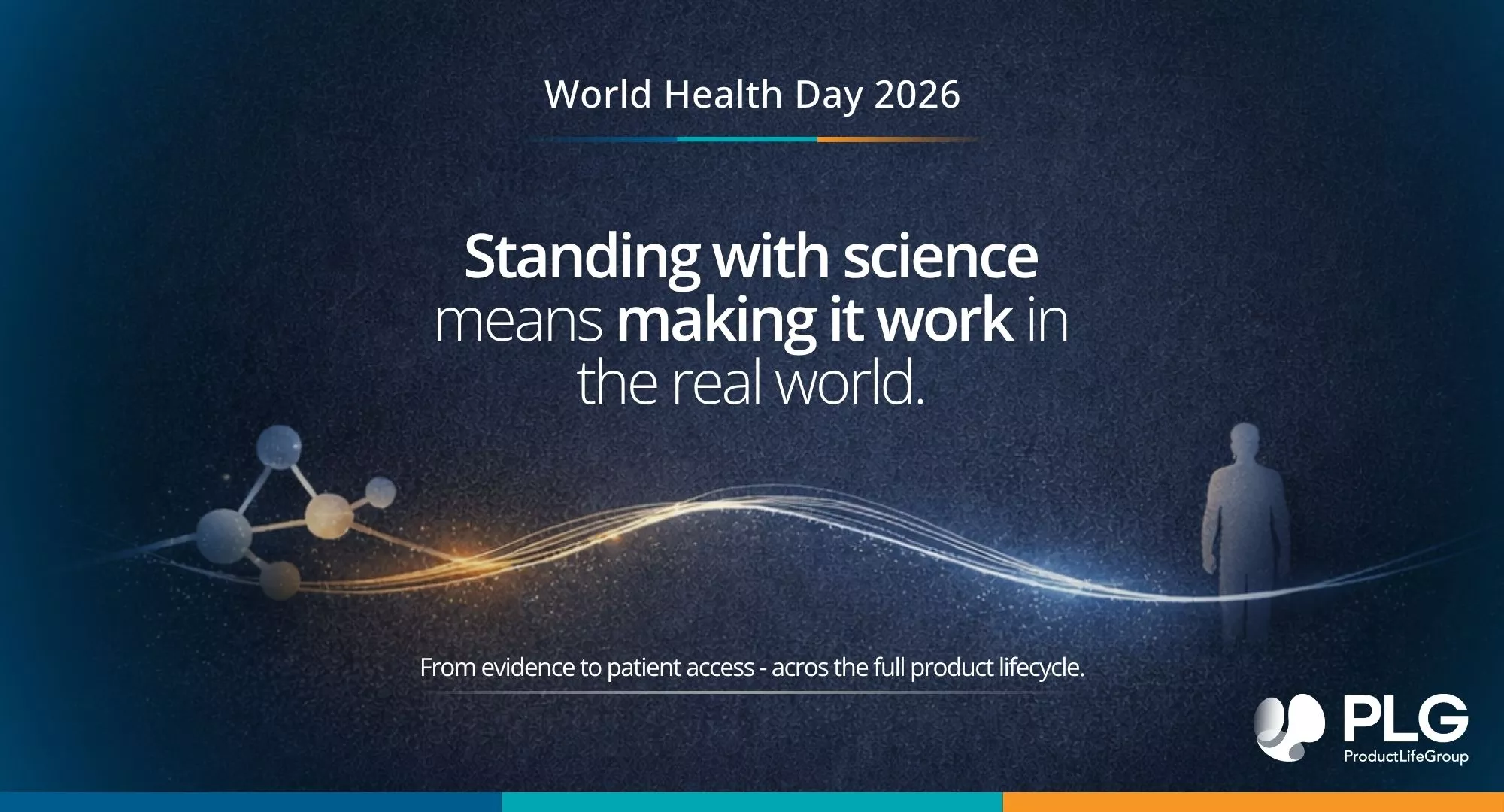
Every year on 7 April, World Health Day gives the global health community a shared moment to pause, reflect and realign. In 2026, the World Health Organization has chosen a theme that carries particular urgency: “Together for health. Stand with science.”
The campaign is a call to governments, researchers, health workers and institutions worldwide to reaffirm their commitment to evidence-based decision-making — and to resist the growing pressure of misinformation, fragmented governance that threatens to erode public trust in science.
For ProductLife Group, this message resonates deeply. Not because it is timely, but because it speaks directly to the work we do every day.
The gap nobody talks about
Standing with science sounds like a simple act. But in the life sciences industry, the real challenge is not whether to trust science, it is how to operationalize it.
Between a scientific discovery and a patient receiving a treatment, there is an immense, complex and often underestimated journey. A journey that involves regulatory submissions, clinical evidence packages, pharmacovigilance systems, quality frameworks, labelling decisions and market access negotiations — all of which must be navigated across different geographies, languages, regulatory cultures and timelines.
Science, on its own, does not cross that distance. It needs infrastructure, expertise and discipline to do so.
This is the gap that rarely makes headlines. And yet it is where innovation can stall, where public health promises can go unfulfilled, and where the credibility of the entire drug development system is ultimately tested.
A moment defined by complexity
The 2026 World Health Day campaign is anchored by two major global events: the One Health Summit in Lyon (5–7 April), co-hosted by World Health Organization and the French Government under the G7 Presidency, and the inaugural Global Forum of WHO Collaborating Centres (7–9 April), bringing together scientific institutions from over 80 countries.
Together, these events form the largest scientific network ever convened around a United Nations agency, a signal that the complexity of today’s health challenges demands a new level of coordination and shared commitment.
The life sciences industry is operating in a moment of extraordinary scientific acceleration. Biologics and advanced therapy medicinal products are redefining what is therapeutically possible. Artificial intelligence is reshaping how clinical data is generated, analysed and submitted to regulators. Digital health tools are expanding the boundaries of trial design and patient monitoring. Global health challenges are growing faster than national systems can respond.
All of this creates remarkable opportunity. It also creates significant operational and regulatory risk, because the faster science moves, the harder it becomes to ensure that everything happening downstream is rigorous, compliant and patient-centered.
Rigor is not the opposite of speed
One of the persistent tensions in life sciences is the perceived conflict between innovation and compliance. Speed versus safety. Ambition versus control.
At ProductLife Group, we believe this is a false dilemma.
Regulatory rigor is not a brake on innovation. It is what makes innovation credible. Evidence-based decision-making is not bureaucratic friction. It is the mechanism through which scientific progress earns the trust of patients, health authorities and healthcare systems around the world.
When WHO calls on the global community to stand with science, it is also — implicitly — calling for the kind of disciplined, systematic work that transforms scientific evidence into real-world health outcomes. That work requires regulatory intelligence, quality governance, pharmacovigilance expertise, clinical rigour and digital capability. It requires organizations that can operate across the full product lifecycle, across geographies, and across the complexity that defines modern life sciences.
What "standing with science" looks like in practice
For our teams at PLG, standing with science is not a posture. It is a methodology.
It means helping sponsors build regulatory strategies that are evidence-led from day one, not retrofitted after development decisions have already been made. It means ensuring that safety data is captured, analysed and communicated in ways that meet both the letter and the spirit of regulatory expectations. It means supporting quality systems that are genuinely functional, not merely compliant on paper. It means thinking about market access not as a commercial afterthought, but as an integral part of how scientific value reaches patients.
And increasingly, it means integrating new digital capabilities in ways that enhance — rather than obscure — the scientific and regulatory integrity of the development process.
A shared responsibility
The World Health Organization campaign calls on governments and institutions to strengthen investment in science, support WHO’s normative role, and embed evidence in health, climate, food and environmental decision-making.
For the life sciences industry, that call has a specific and practical translation: build the organizational capacity to ensure that good science leads to good outcomes.
Not occasionally.
Systematically.
At ProductLife Group, this is both a conviction and a daily commitment, because scientific progress delivers its full value only when it becomes real-world progress, for companies, for health systems, and ultimately for patients.
ProductLife Group supports life sciences organizations across the full product lifecycle, from early development and regulatory affairs to pharmacovigilance, quality, market access and digital transformation.
Register to our news and events
Go to our Events to register
Go to our News to get insights