ONLINE EVENT
Data migration and system integration in Life Sciences have followed familiar patterns for more than two decades. Yet today, the landscape has fundamentally changed. The rapid expansion of SaaS platforms, cloud-based environments and digital tools has made data easier to generate — but significantly more fragmented, decentralized and complex to manage.
As data-driven strategies become embedded in modern governance models, organizations are facing a widening gap between traditional migration approaches and the demands of scalable, inspection-ready digital ecosystems.
Manual, resource-intensive migration programs are no longer sustainable. Incompatible data structures, inconsistent taxonomies, unstructured legacy content and limited automation often delay Day-1 readiness and increase operational and regulatory risks.
These challenges become even more critical during high-impact transitions such as:
Migration to modern platforms such as Veeva Vault
Consolidation of multiple systems across functions or regions
Retirement of legacy applications
M&A separations or integrations
In these scenarios, data integrity is not only an operational concern — it is a regulatory requirement.
Without structured remediation, standardization and governance, organizations risk transferring incomplete, misaligned or non-compliant datasets into new environments.
Modern migration programs require a fundamentally different approach — one that combines structured methodology with intelligent automation.
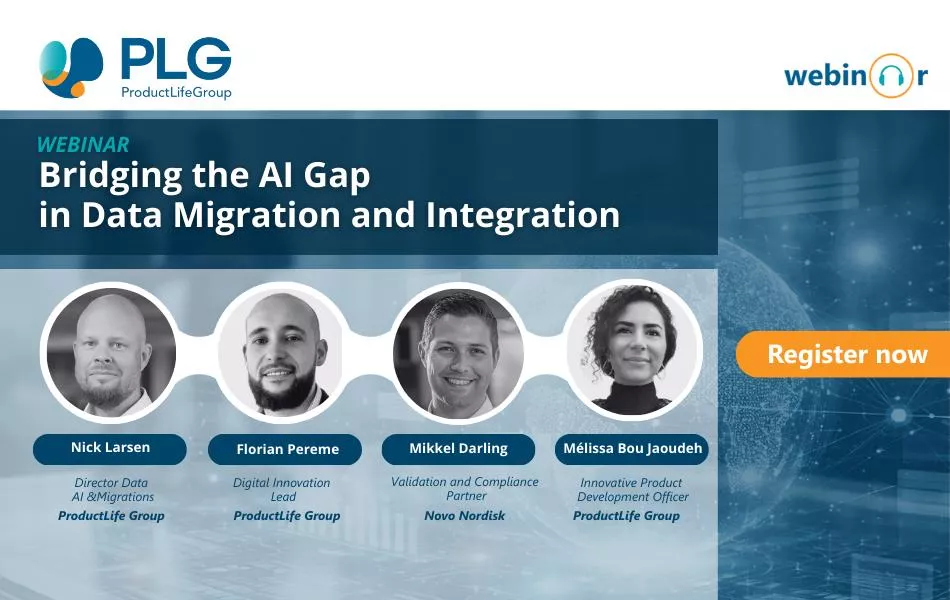
In this upcoming ProductLife Group webinar, we will explore how organizations can modernize their data migration and integration strategies through:
End-to-end data migration across Regulatory, Quality, Clinical, Safety and Commercial domains
System consolidation and integration across Veeva Vault, ERP/CRM, CTMS/eTMF and legacy platforms
Data remediation and standardization, including taxonomy alignment and master data cleanup
AI-driven automation to accelerate preparation, mapping, quality control and validation processes
By integrating automation and AI into migration workflows, companies can reduce manual effort, improve data quality, and enhance traceability — while maintaining compliance with evolving regulatory expectations.
Data migration is often underestimated as a technical exercise. In reality, it is a cross-functional transformation program that directly impacts regulatory operations, quality systems, clinical oversight and commercial readiness.
Common pitfalls include:
Misaligned governance models
Insufficient remediation before system cutover
Poor visibility on data lineage and validation
Underestimated compliance exposure during M&A transactions
A structured and automated approach enables organizations to reduce risk, control timelines and preserve internal bandwidth — particularly when resources are already stretched across transformation initiatives.
📅 Thursday, March 26, 2026
🕒 15:00 – 16:00 (CET)
🎙 Speakers: Nick Larsen, Florian Pereme Ph.D, Mikkel Emlington Darling
🎤 Moderator: Melissa Bou Jaoudeh
Go to our Events to register
Go to our News to get insights