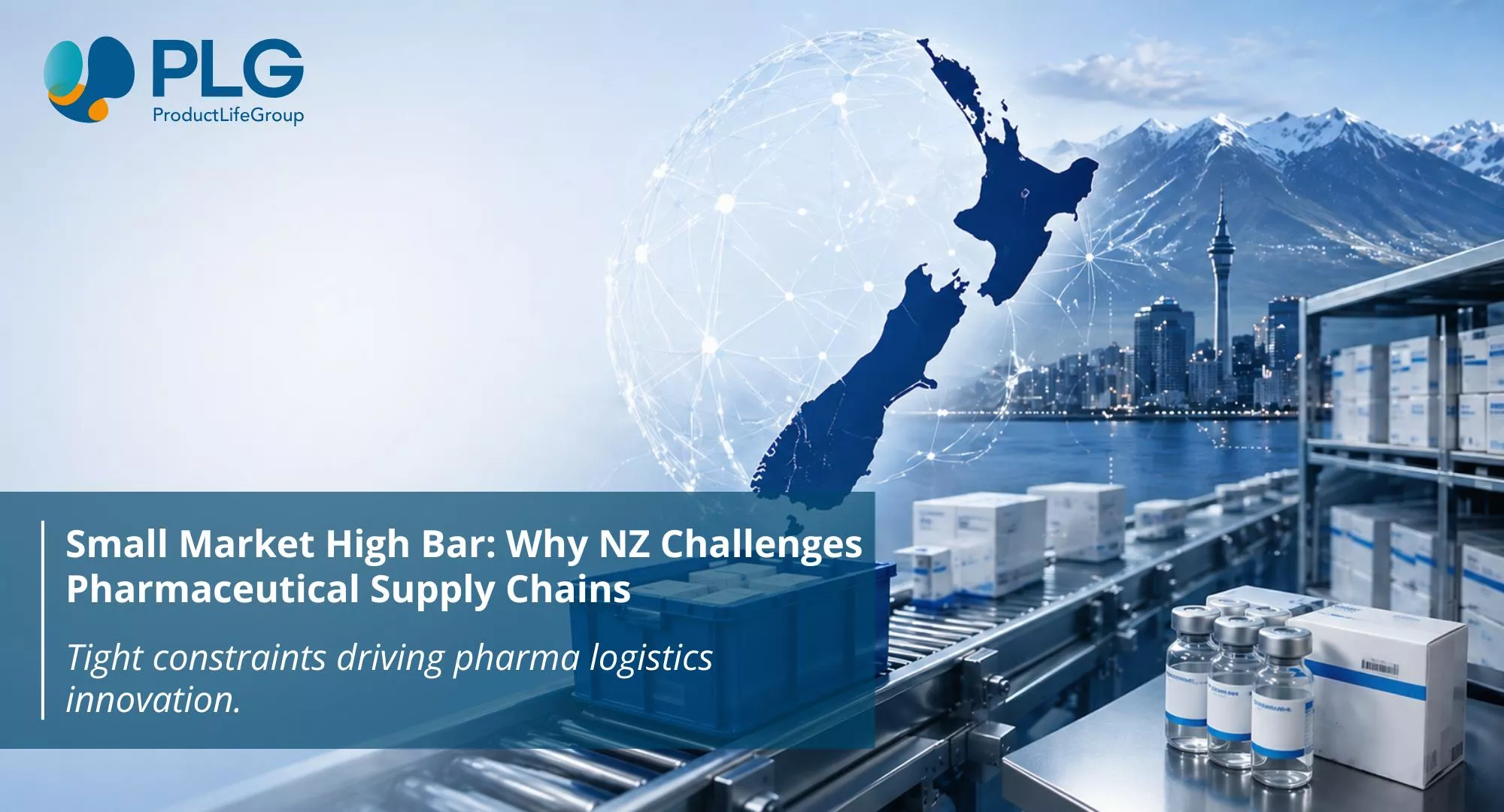
Small Market, High Bar: Why New Zealand Challenges Pharmaceutical Supply Chains
30 april 2026
Small Market, High Bar: Why New Zealand Challenges Pharmaceutical Supply Chains
Authors:
Stephanie ludica – Manager, Regulatory, Quality & Compliance, Commercial Eyes
Jason Mai – Regulatory Affairs Associate Consultant, Regulatory, Quality & Compliance, Commercial Eyes
Jamie Taylor – Director, Business & Commercial Development at DHL Supply Chain (NZ)
Meg Rolton – Business Development Manager at DHL Supply Chain
What are the current challenges and opportunities shaping New Zealand’s warehousing and distribution market?
The warehousing and distribution market in New Zealand is currently facing several challenges that significantly impact businesses in the sector, including:
- Rising costs for property, utilities, labor, and transportation. These increased expenses can strain profit margins, forcing companies to reevaluate their pricing structures and consider how to pass on these costs.
- Local regulations and compliance requirements, particularly those set by Pharmac, the Pharmaceutical Management Agency for New Zealand, is responsible for managing the country’s pharmaceutical funding and plays a significant role in shaping the market. Pharmac determines which medicines and medical devices are subsidized by the government, negotiates pricing and contracts with pharmaceutical companies, and develops clinical guidelines for the use of these products. Understanding and adhering to these regulations is essential for businesses operating in the pharmaceutical sector, as navigating the regulatory landscape can create complexities and challenges.
- New Zealand’s relatively small population and lack of scale can lead to inefficiencies. Smaller volumes required to support the market can make it challenging for businesses to achieve economies of scale. Additionally, New Zealand’s geographical location results in high transportation costs for importing goods, particularly when dealing with small volumes. In such cases, there may not be a legal entity established in New Zealand, necessitating the outsourcing of product sponsorship activities to ensure compliance with local regulations.
- Limited availability of a temperature-controlled logistics network which can hinder the distribution of sensitive products, such as pharmaceuticals, which are critical for maintaining product integrity.
Despite these challenges, there are numerous opportunities that can shape the future of the warehousing and distribution market in New Zealand. Technological advancements present significant potential for improving operational efficiency and reducing costs. Innovations in automation, robotics, artificial intelligence (AI), and data analytics can streamline processes, enhance inventory management, and facilitate better decision-making. Moreover, the development of specialized infrastructure, such as cold chain storage for temperature-sensitive products, controlled drugs, and dangerous goods, is becoming increasingly important as the demand for these services grows.
DHL Supply Chain is proactively addressing these challenges and capitalizing on opportunities. With a recent investment of $90 million NZD in a warehouse facility tailored to the New Zealand market, DHL offers a versatile space that accommodates multi-user profiles and achieves economies of scale. The facility incorporates automation and robotics to enhance efficiency and accuracy, along with specialized storage areas for temperature-sensitive products, including those requiring two-eight degrees, freezers, controlled drugs, and dangerous goods.
Additionally, to navigate regulatory challenges, DHL has established a Quality and Compliance team of 15 members who provide in-depth guidance on regulatory matters for customer compliance.
If I was a client considering importing a product, what three questions should I be asking potential logistics and warehousing providers to ensure my product will be managed properly?
When considering importing a pharmaceutical product to New Zealand, it is essential to ensure that your logistics and warehousing providers can adequately manage your product’s specific needs.
Here are three critical questions you should ask:
1. What are your warehousing and facility capabilities including certifications, storage capabilities, and national scale?
When considering a logistics and warehousing provider for importing pharmaceutical products, it is essential to inquire about their warehouse certification coverage, facility capabilities, and operational scale across New Zealand. Specifically, ask about relevant certifications such as Good Manufacturing Practice (GMP), International Organization for Standardization (ISO) standards, MedSafe licenses, and any other relevant accreditations specific to your product profile to ensure compliance with industry regulations.
Additionally, assess the provider’s facility capabilities, including temperature-controlled storage options (eg 15-25 degrees, 2-8 degrees), dangerous goods capacity, controlled drugs capacity, inventory management systems, packaging capabilities, labelling and rework abilities to confirm they can meet the specific requirements of your products. Finally, understanding the provider’s operational scale, including the presence of multiple facilities in key locations like Auckland and Christchurch, will help determine their ability to support your logistical needs effectively as your business grows.
2. What quality control systems and support do you have in place?
In the pharmaceutical industry, having the right quality control systems and support in place is paramount. Inquire about the quality control systems implemented by the logistics provider.
3. How will you supply the product to market?
Understanding how your product will be supplied to market is crucial for ensuring efficient distribution and availability to end users. Ultimately, the choice of supply method should align with your overall business strategy, market goals, and the specific requirements of your pharmaceutical products.
By discussing these options with your logistics and warehousing provider, you can ensure that your product is supplied to market in a manner that maximizes efficiency and meets the needs of your customers.
It was great to visit the site last year and see the operation firsthand. How is the new NZ site and facility helping DHL meet New Zealand’s growing demand for compliant and secure pharmaceutical warehousing?
DHL Supply Chain New Zealand opened its new life science and healthcare facility in October 2025, located on Te Kapua Drive in Auckland. This state-of-the-art, 14,000 sqm automated site is specifically designed to address the growing demand for compliant and secure pharmaceutical warehousing in New Zealand.
The facility enhances DHL’s ability to meet local requirements through the implementation of Goods-to-Person automation, supported by 41 Geek+ robots and Very Narrow Aisle (VNA) storage solutions. The automation was designed for the New Zealand market and therefore the multi-user solution best suits small unit picks for parcel deliveries. One of the key benefits of this automation is the ability to perform automated quality control checks based on product weight and size, significantly reducing the risk of mis-picks, human error, and improving inventory accuracy. This level of precision is crucial for maintaining compliance with stringent pharmaceutical regulations.
Moreover, the automation not only enhances productivity but also enables DHL to effectively manage surges in demand without the need for additional labour. This capability is essential in a rapidly evolving market where the need for timely and compliant distribution of pharmaceutical products is paramount. Overall, the new facility positions DHL to better serve the pharmaceutical sector in New Zealand, ensuring that clients receive secure and compliant warehousing solutions tailored to their needs.
Having visited the site last year and seen its local capabilities in action, it’s clear the facility plays an important role within DHL’s wider network. How will this facility connect with DHL’s broader Asia-Pacific logistics network to support efficient import and export flows for healthcare products?
The new Te Kapu Drive Facility is strategically designed to integrate seamlessly with DHL’s extensive local New Zealand network and Asia-Pacific logistics network, enhancing the efficiency and flow for healthcare products.
By adhering to core DHL service standards and shared Standard Operating Procedures (SOPs) across the Asia-Pacific region, the Te Kapu Drive Facility will ensure consistency in service delivery. This alignment facilitates smoother operations, reduces operational discrepancies, and enhances the overall customer experience, making it easier to manage healthcare product flows.
Furthermore, the facility can leverage DHL Global Forwarding’s (DGF) joint supply chain capabilities, allowing for streamlined coordination of import and export activities on a global scale. This integration ensures that healthcare products can be efficiently moved across borders, utilising DGF’s established logistics routes and expertise. The facility can accommodate a comprehensive range of transport solutions, including air, sea, and ground services, tailored to the specific needs of healthcare products. This flexibility ensures that time-sensitive shipments are prioritized and delivered efficiently, which is crucial for the healthcare sector.
How is DHL leveraging automation or AI to improve efficiency, accuracy, and visibility for clients in highly regulated sectors?
Digitalisation and data analytics play a crucial role in optimising warehouse operations and ensuring regulatory compliance. From a warehouse optimization perspective, automating repetitive tasks such as inventory management and order processing enhances operational efficiency, reduces human errors, and increases processing speed. Implementing a robust digital warehouse management system can allow us to leverage real-time monitoring through data analytics to provide valuable insights into warehouse operations, enabling better decision-making and quicker responses to challenges.
In terms of regulatory compliance, digital systems can automate and support reporting, ensuring that all regulatory requirements are met and that detailed records are maintained. DHL utilises a digital system called ETQ to support all quality compliance activities across the business both in New Zealand and Australia. ETQ manages various quality processes, including document control, change management, non-conformance reporting, and corrective and preventive actions (CAPA). This system provides tools and features that facilitate compliance with industry standards, improve operational efficiency, and enhance overall product quality.
Supported by the Warehouse Management System (WMS) Manhattan Active, customers can fully integrate their systems for enhanced visibility across their supply chains.
Additionally, DHL provides clients with digital platforms, such as My Supply Chain, which offer real-time visibility into their supply chains, enhancing transparency across warehousing and transportation.
How would you suggest clients build more resilient and flexible supply chains in the face of global disruptions?
To navigate global disruptions effectively, clients must focus on building resilient and flexible supply chains. Several strategies to consider include:
- Collaborative Partnerships: Establishing strong and collaborative partnerships across all areas of the business is essential. This not only fosters trust and communication on a day-to-day basis but also creates a solid foundation for collaboration during times of disruption.
- Robust Systems and Procedures: Implementing advanced systems, such as Warehouse Management Systems (WMS) and Transport Management Systems (TMS), is critical. These technologies enhance operational efficiency, reduce reliance on manual labour, and mitigate risks associated with disruptions.
- Automation: Adopting automation in warehousing and logistics processes can significantly improve flexibility and responsiveness, allowing businesses to quickly adapt to changing conditions.
- Risk Management Strategies: Developing comprehensive risk management strategies with suppliers is crucial. This includes conducting regular risk assessments, scenario planning, and creating Business Continuity Management (BCM) plans to prepare for potential disruptions.
- Continuous Improvement: Regularly reviewing and refining supply chain strategies based on performance metrics and feedback can help identify areas for improvement and ensure ongoing adaptability.
By focusing on these areas, clients can build supply chains that are not only resilient in the face of global disruptions but also flexible enough to adapt to changing market conditions.
From your perspective, how can collaboration between logistics providers, healthcare companies, and regulators strengthen New Zealand’s supply chain resilience?
Collaboration between logistics providers, healthcare companies, and regulators can significantly strengthen New Zealand’s supply chain resilience in several ways:
- Regulatory Support and Compliance: Engaging with regulators early in the product development and distribution process can help identify potential barriers and streamline compliance requirements. This proactive approach fosters a more responsive regulatory environment that can adapt to the dynamic needs of the healthcare sector, ultimately leading to a more resilient supply chain.
- Enhanced Product Flow: Effective collaboration allows for the optimization of the movement of products into New Zealand. By working closely together, logistics providers and healthcare companies can streamline processes that facilitate the rapid introduction of new products to the market. This collaboration can lead to the development of efficient pathways for regulatory approvals and product distribution, ensuring that critical healthcare products are available when needed.
- Innovation and Best Practices: Regular communication and partnership among logistics providers, healthcare companies, and regulators can lead to the sharing of best practices and innovative solutions. This exchange of knowledge can drive improvements in logistics processes, technology adoption, and overall supply chain efficiency.
A collaborative approach among logistics providers, healthcare companies, and regulators not only facilitates the efficient movement of products but also enhances New Zealand’s ability to respond to market demands and unexpected challenges, ultimately strengthening the resilience of its supply chain.
Need support in New Zealand’s pharma market? Contact us to get started:
The Authors
Register to our news and events
Go to our Events to register
Go to our News to get insights