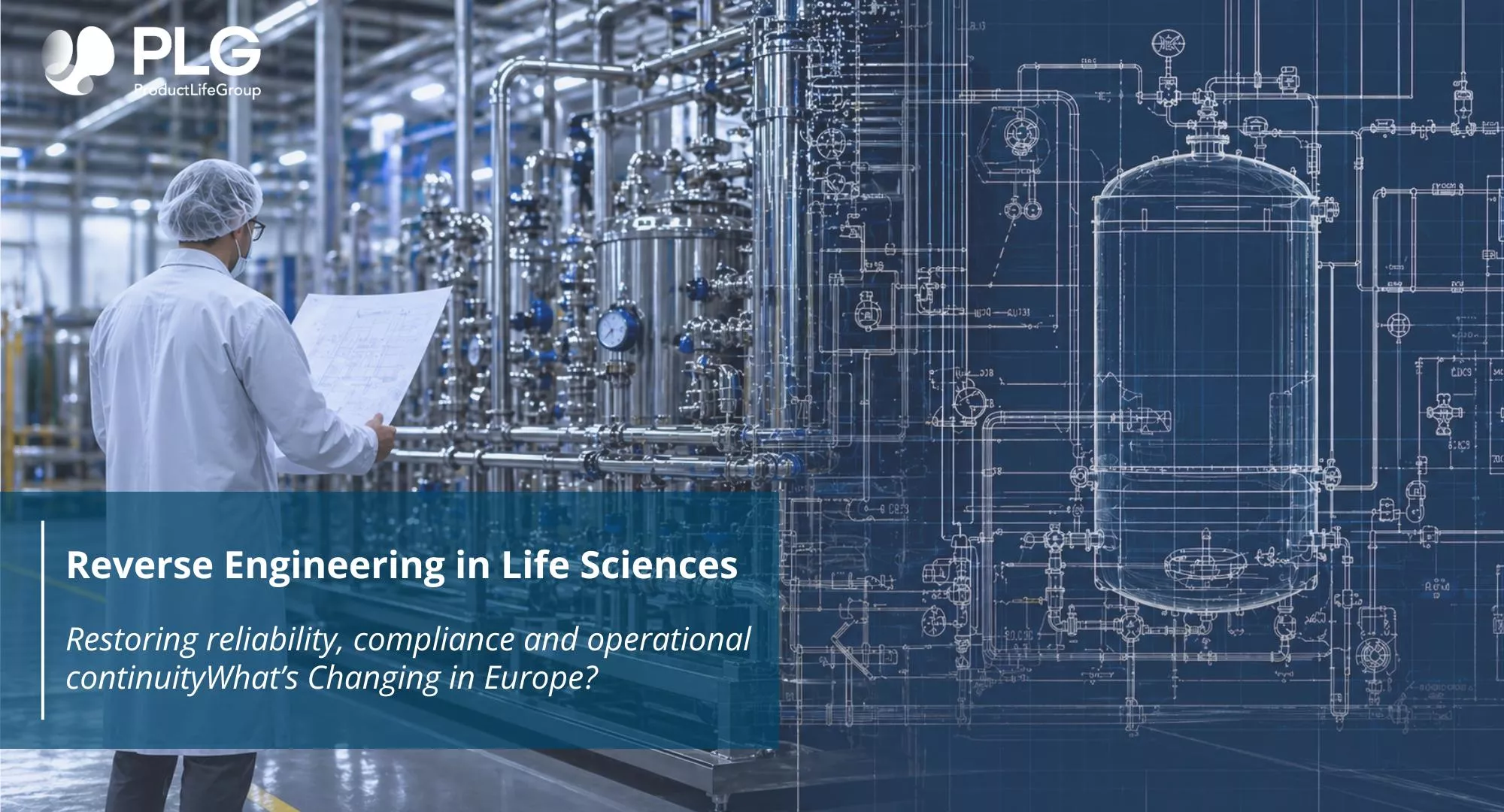
Rebuilding What’s Lost: Reverse Engineering for Reliable, Compliant Manufacturing
28 april 2026
Rebuilding What’s Lost: Reverse Engineering for Reliable, Compliant Manufacturing
What if you found yourself working within a perfectly functioning system, but without instructions, without diagrams, and without historical memory?
In the pharmaceutical and biotech world, where every detail matters and compliance is non-negotiable, this is not a rare outcome. Instead, it’s a reality that is far too common. It is precisely in these scenarios when reverse engineering comes into play – an approach transforming uncertainty into knowledge, bringing to light design logic, hidden functionality, and forgotten know-how.
Starting from the final result and working backwards, reverse engineering allows you to reconstruct what has been lost over time at a manufacturing plant, from documentation, skills, and process knowledge. This activity is critical because it allows for operational continuity, even in the absence of original design sources or historical know-how. Furthermore, it reduces the risk of plant downtime and allows for targeted intervention on obsolete or no longer supported systems. It’s not just about analyzing, but also interpreting, improving, and making production-critical systems reliable again.
What is Reverse Engineering?
Reverse engineering is the process of analyzing a product, device, or system to better understand its design, construction, or functionality, often without having access to the original plans or source documentation.1 It’s a backward way of working, starting from the final product to deduce its design principles and specifications.
The process is divided into:
- Physical data acquisition
- Deconstruction
- Functional analysis
- Design and functionality understanding
- Reconstruction or duplication
Application in Life Sciences
Pharmaceutical and biotech companies are required to follow regulatory guidelines, known as GXPs, designed to ensure the safety, quality, and efficacy of products intended for human use.2,3 These guidelines provide the framework to build a quality system, validate and control every process, ensure data integrity and traceability, manage risks, and always demonstrate compliance with documentary evidence.
Many pharmaceutical and biotech companies were established well before the adoption of such guidelines, so they may find themselves with the following:4,5
- Obsolete systems: Systems or components, whether still functioning or not, dated as to be out of production and requiring a revamp.
- Lack of as-built documentation: Having a different conception of engineering, much of the original design and construction documentation was not preserved; or, in the absence of digital media, physical copies were lost.
- Absence or loss of know-how because of an incorrect handover.
Often, these companies need to move or replicate a production process they possess. In this context, reverse engineering is used to study the process technology in detail, seeking to improve its technical, compliance, and safety aspects.
PLG’s Center of Excellence in Engineering
The most frequent situations we face as members of PLG’s Center of Expertise Engineering unit concern dated, stationary, or inoperable or unclear systems and components, requiring us to carry out improvements, maintenance, or technology transfers.
Reverse Engineering Case Study – Revamping
While engaging with one of our key clients, we found ourselves facing an existing system, installed, and apparently complete, but never actually operational.
More specifically, an ethylene glycol tank kept at 6 °C, a pump ready to relaunch the product to department users, yet no one knew exactly how to make it work.
Over time, this system had become a black box – designed by a now-defunct team, depleted some of its original components, reused elsewhere on the site, and with no documentation.
Our challenge was clear:
- Return know-how to plant staff
- Reproduce supporting documentation
- Reintegrate missing components
- Get the system up and running
How did reverse engineering help us in this case?
We started a discussion with the site staff to understand their operational needs, moved on to the archives, and went back to the available installation documents. Thanks to a series of field inspections, we verified the system’s condition and, in dialogue with the tank and pump suppliers, we traced and reconstructed the system’s operating logic.
Once we identified the starting information, we updated the Piping & Instrumentation Diagrams (P&IDs) and developed the operating logic to be implemented into their Distributed Control System (DCS). Subsequently, together with the site maintenance staff, we carried out functional field instruments checks (pressure gauge, temperature indicators, level indicators, solenoid valves, etc.) and proceeded to replace the components that had been uninstalled and reused elsewhere.
Following a comprehensive engineering effort, the system was ultimately restored to operation, transforming a critical black box into a reliable production asset.
Reverse Engineering Case Study – Technology Transfer
Production process transfer goes far beyond replication. It means enabling the process to operate effectively in a new environment, safeguarding efficiency and product quality, and, where possible, enhancing critical performance elements. It represents a complex technical and integration challenge.
This is exactly what we faced in a major project for a well-known multinational pharmaceutical company.
The objective was to replicate three Active Principle Ingredients (API) production processes from one of their sites abroad to one of their sites in Italy. The complexity in this case was not only the replication of the production process, but the integration of that process within an already existing plant and the contribution of improvements to achieve good manufacturing practice (GMP) compliance.
The first step was to acquire all documentation related to existing plants and then proceed with the analysis and study of the processes.
Based on this information, we sized the equipment and utilities in service and designed a cleaning in place (CIP) system. We then redesigned the connections to make them fully self-draining and free of dead legs. To further ensure the absence of product contamination, we improved the loading system by integrating a Pneumatic Transfer System (PTS), allowing indirect product handling.
Finally, we performed a 3D simulation, verifying the correct integration between the new system and the existing one. Through this structured approach, we successfully completed the project and built the plant, implementing significant improvements compared to the original configuration.
Conclusions
Reverse engineering is a fundamental tool in an ever-changing industry such as life sciences, where regulations are constantly evolving, requiring a relentless tracking of every intervention performed at the manufacturing plant.
Although the most common challenges concern the obsolescence of systems, particular attention should be paid to cases where customer know-how is partially or completely lacking. In these cases, we recommend a more structured and pronounced approach:
- Verification of documentation available from the customer (Data acquisition)
- Engagement with experienced suppliers and technicians to fill identified gaps (Deconstruction)
- Study of all information related to the system under examination (Analysis and understanding)
- Production of as-is documentation and current-state report (Reconstruction)
To restore the know-how to a client, a multidisciplinary effort is required, for which you need a highly skilled team, solid experience in the sector, and the right tools.
With over 20 years of experience, PLG’s Center of Excellence Engineering supports its customers in transforming uncertainty into clarity, legacy systems into reliable assets, and complexity into opportunity. Our team thrives on new challenges and stands ready to support you whenever reverse engineering is the key to moving your project forward.
We partner with early-stage companies, CEOs, and investors to bring engineering expertise with global reach, helping teams execute discipline across critical inflection points.
Ready to begin the conversation? Contact our team.
References
- Kumar, A.; Jain, P. K.; Pathak, P. M. Reverse Engineering in Product Manufacturing: An Overview.
- European Commission. EudraLex – EU Legislation on Medicinal Products. European Commission.
- U.S. Food and Drug Administration. 21 CFR Parts 210–211: Current Good Manufacturing Practice (cGMP) for Finished Pharmaceuticals.
- World Health Organization. Good Manufacturing Practices (GMP): Guidance and Global Adoption.
- QMS Templates. Origins of GMP and International Harmonization (including International Council for Harmonization of Technical Requirements for Pharmaceuticals for Human Use, from 2000).
Ready to restore your systems and ensure compliance? Contact our team to discuss how reverse engineering can support your manufacturing operations:
Register to our news and events
Go to our Events to register
Go to our News to get insights