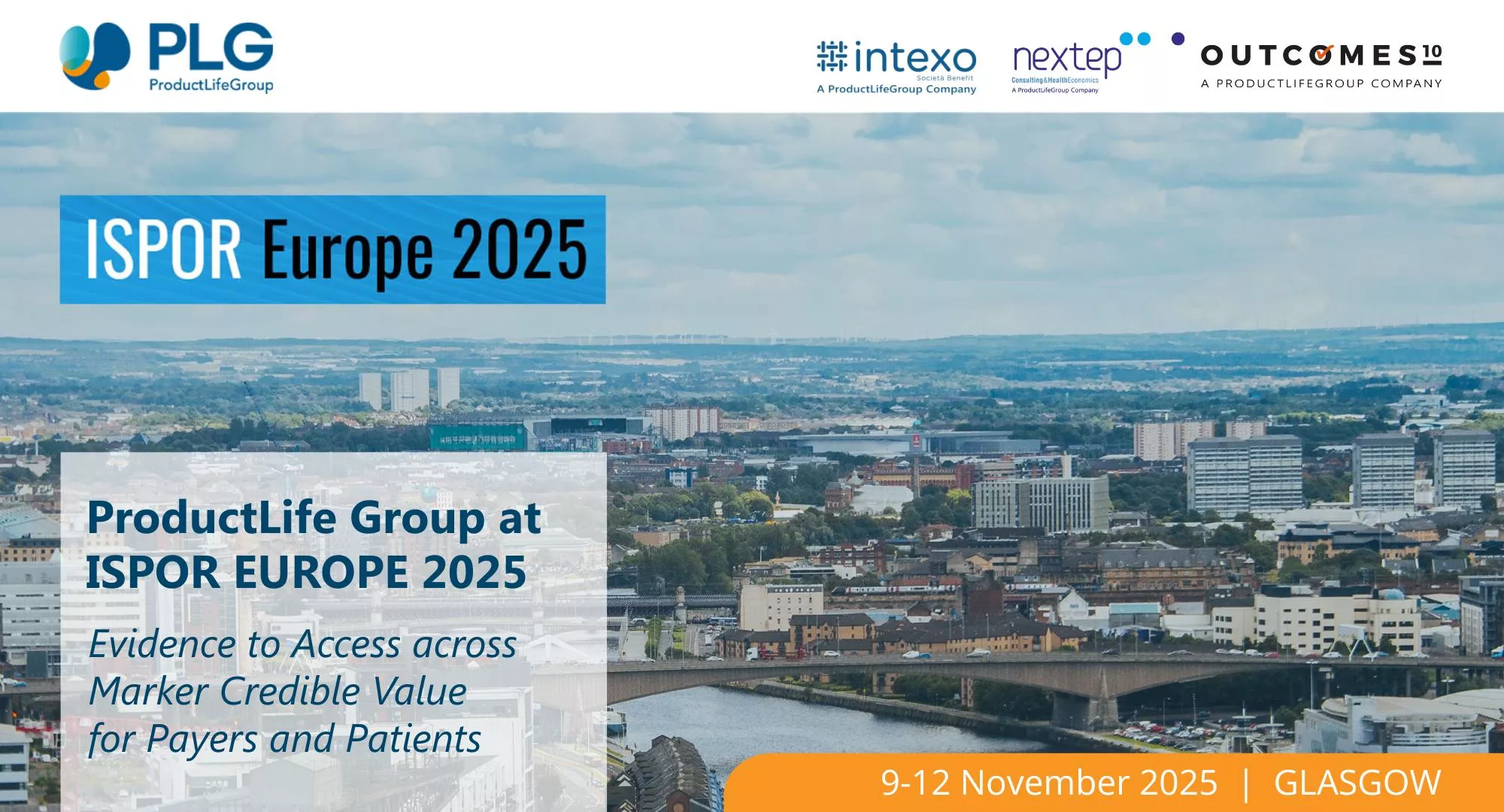
PLG at ISPOR Europe 2025: from evidence to access, with real impact for patients
November 9, 2025
- November 12, 2025
Glasgow
ISPOR Europe is one of the key milestones for anyone working at the intersection of evidence, value, and access. In Glasgow, from 9–12 November 2025, ProductLife Group participated together with affiliates Intexo Società Benefit, Outcomes’10 and Nextep Health with a clear message: turn data and insights into decisions that matter for HTA, pricing & reimbursement and Market & Patient Access across European health systems.
Highlights from the conference
Conversations on site revolved around four pillars that match payer and decision-maker priorities:
- Access and value: building credible value narratives, rooted in clinical and real-world outcomes, to support negotiation and reimbursement
- HEOR and RWE: robust designs and cost-effectiveness/budget-impact models that withstand methodological and regulatory scrutiny
- HTA and health policy: understanding how countries interpret cost-effectiveness thresholds, evidence requirements, and performance-based agreements
- Patient-centred programs: embedding patient priorities, preferences and quality of life so value translates into tangible results for people
Posters and scientific contributions
The PLG team contributed to the event presenting 11 posters, offering comparative and practical perspectives on topics that determine access today:
- Resilient Pharmaceutical Supply Chains in Times of Crisis – A comparative analysis of Australia, France, Italy, Spain and the UK: how medicine supply chains respond to shocks and which regulatory/organizational levers strengthen resilience
- Relationship Between Cost-Effectiveness Threshold and Drug Reimbursement in Spain, Italy, and France – Links between cost-effectiveness thresholds, HTA criteria and reimbursement decisions
- Joint Clinical Assessments and evaluations with non-RCT evidence – Methodological and regulatory implications in the evolving European context
- Psoriasis: from a review of patient decision aids to understanding drivers of patient choice and measuring quality of life with DLQI-R in older populations
- Cost of Care in relapsing-remitting multiple sclerosis (Spanish NHS perspective) and healthcare/economic burden of IV/SC immunoglobulins across three autoimmune neuromuscular diseases (bicentric Spanish experience)
- Country-specific economic evaluations, including:
– Cost-effectiveness of difelikefalin for CKD-associated pruritus in haemodialysis (Italy)
– Nemolizumab for moderate-to-severe prurigonodularis (Italy)
- Evolution of pharmaceutical pricing and reimbursement agreements in Spain over the last decade, moving toward outcomes-based approaches
A common thread runs through these works: giving decision-makers operational tools. Not just results but replicable methods, transparent assumptions, tested sensitivities and clear guidance on turning evidence into informed negotiations, country-aligned dossiers and sustainable adoption.
From methodology to execution
Discussions at our booth reinforced several cross-cutting needs:
- Link evidence and access early: integrate HEOR/RWE inputs during development to avoid late rework that delays time-to-access
- Localize without losing coherence: a common framework for multiple countries, with targeted adaptations to requirements, available data and stakeholder priorities
- Choose the right outcomes: clinical endpoints, PROs, and quality-of-life measures that speak the language of payers and clinicians
- Governance and measurability: processes, metrics, and versioning that ensure traceability and speed across submission, negotiation, and follow-up
How PLG supports teams
With an integrated network of capabilities, PLG partners with biopharma and medtech companies along the full journey from evidence to access:
- Market & Patient Access: early asset positioning, pathway mapping, stakeholder engagement
- Pricing & Reimbursement / HTA: value dossiers, negotiation strategies and responses aligned to national requirements
- HEOR: rigorous, defensible cost-effectiveness and budget-impact models
- RWD/RWE: study design, evidence generation, and translation of insights into payer-relevant decisions
- Patient-centred Research: tools, preferences, and quality of life to connect science, experience, and value
- Market Intelligence: competitive, epidemiology, and policy monitoring to inform country prioritization and timing
Our approach is pragmatic and repeatable: shared methodological structures tailored to local contexts, transparent assumptions, and a constant focus on credibility and sustainability of proposed solutions
Looking ahead
Pressure on sustainability, value-for-money, and measurable outcomes will keep increasing. That’s why we invest in models and skills that help teams prepare early, aligning study pipelines with HTA and negotiation needs, and turning evidence into access and impact for patients.
ISPOR 2025 marked an important step in this direction: a place to shift the dialogue from “what data?” to “what decisions can we take, now?”
If you’re interested or would like to explore further, contact us
Register to our news and events
Go to our Events to register
Go to our News to get insights